So what exactly is a “liberal arts education?”
And why you might want one
Last updated July 25, 2026
By Eric Tipler, college admissions counselor and author of Write Yourself In
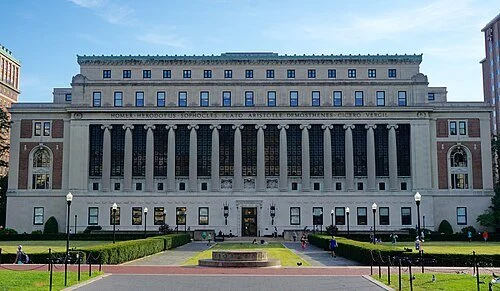
Columbia University prides itself on offering a liberal arts education (Photo by JSquish)
A liberal arts education includes study of the arts, sciences, and humanities, with a focus on developing strong critical reasoning skills and the ability to think broadly. It’s considered the standard college experience in the United States (but not in most other parts of the world). Understanding a liberal arts education can sharpen your college search process and help you write stronger application essays.
Understanding the liberal arts education
If you’re applying to selective colleges and universities, the term “liberal arts education” is likely to come up. It refers to a course of instruction that has been standard in the USA for over a century: a broad-based study of the social sciences (e.g. economics, psychology), natural sciences (e.g. physics, chemistry), arts (e.g. music, fine art), and humanities (think English, philosophy). Many educators (including myself) believe strongly that this type of education teaches you how to think critically, creatively, and — just as important — become an engaged citizen in a democracy.
In fact, when most people think of a “college education,” they’re envisioning a liberal arts education with a specialization in one or more fields. That specialization is, of course, called a “major” (or a “concentration” at a few schools, notably Harvard and Brown). Your other liberal arts courses will be called “distributional requirements,” “general studies,” or something along those lines. Unless you’re pursuing a specialized, pre-professional degree like engineering or the visual/performing arts, if you go to college in the USA you’re probably getting a liberal arts education.
To make things a bit confusing, some schools — notably Columbia University and the University of Chicago — have particular implementations of the liberal arts. Columbia’s Core Curriculum focuses on “great books,” while UChicago’s Core emphasizes critical thinking. Yale’s Directed Studies program (which is small; open to less than 10% of their freshman class) is organized around classic texts. Think of these programs as each school’s “custom-branded” implementation of the liberal arts. Regardless of the name, all three still give you a liberal arts education.
How does this affect my application essays?
Understanding a liberal arts education can help you write better Why Our School essays. For example, take a look at these supplemental essay prompts:
Princeton University
As a research institution that also prides itself on its liberal arts curriculum, Princeton allows students to explore areas across the humanities and the arts, the natural sciences, and the social sciences. What academic areas most pique your curiosity, and how do the programs offered at Princeton suit your particular interests? (250 words)
Yale University
Why Yale? Reflect on how your interests, values, and/or experiences have drawn you to Yale. (125 words)
While a good response to these questions will almost certainly address your potential major, it could also address why you want a liberal arts education, and how this particular school can help you achieve your goals. This can be especially important when students with niche interests like music performance or engineering apply to liberal arts schools like the Ivies; it helps the admissions committee understand why you want to be at their school, as opposed to, say, Juilliard or MIT.
How to write about the liberal arts
When my students need to write about the liberal arts, I suggest they start by going to the horse’s mouth and reading what the colleges themselves have to say. Reading multiple sources helps you sort through your ideas and figure out what you want to say, as opposed to just spitting back the first thing you saw. (Not coincidentally, this approach to reading and thinking is also at the heart of a liberal arts education!)
Harvard, Yale, and Princeton each have a slightly different take on what the liberal arts means. Swarthmore has a great description as well, written from the perspective of an LAC (liberal arts college), not a university. And Dartmouth recently posted an essay by history professor Cecilia Gaposchkin that asks the question: “What use is a liberal arts education in the age of ChatGPT?”
Finally, the University of South Carolina-Aiken used to proudly display one of the best arguments for a liberal arts education on their website. It’s since been removed, but thanks to the Wayback Machine it’s reproduced below.
Read these to learn more
What is a liberal arts education and why is it important?
(From the USC-Aiken website, archived 6/4/2023 on the Wayback Machine)
You may have heard of a liberal arts education, but do you know exactly what it is and why it is important as you move forward in your life and career? USC Aiken provides our students with a liberal arts education to help better prepare them for their future, and we want you to understand why.
First, let’s answer the question- what is a liberal arts education? A liberal arts education is one that exposes students to many fields, not just those specific to their majors, to empower and prepare the student to think critically, analyze issues, develop a sense of social responsibility, and acquire a broader knowledge of the world in which they live. These studies help students become more well-rounded individuals, and help them adapt to diversity and change.
Students will be trained in-depth in their majors, but will also have general courses of study that may include philosophy, languages, religion, history, literature, economics and mathematics. These are subjects that teach students practical skills like the ability to communicate, think for themselves, and solve problems.
But, here’s the better question – why should a liberal arts education be important to me? There are many benefits to a liberal arts education, the most important being this type of degree is very appealing to prospective employers. If you were hiring employees, wouldn’t you want someone who has demonstrated their abilities to communicate with strong verbal and written skills? Wouldn’t you want an employee who can think critically, analyze issues, and solve problems? Of course you would. These are skills that will transfer to any work place, and these are the skills a liberal arts education helps provide. You will have demonstrated that you know how to apply knowledge and skills, and this will help you work in a variety of fields.
If you want to continue your education by attending graduate school, you will be an appealing candidate because you have already proven you can learn many subjects.
Ultimately, a liberal arts education doesn’t just prepare you to get a job or to get into graduate school. It helps you prepare for life in a world that is constantly changing. You will not only have a better understanding of the world around you; you will also have the skills to become a valuable asset to your community.
A note to parents: A great education is one of the most precious gifts you can pass on to your child. If you'd like help with college admissions, you can learn about working with me, check out my book Write Yourself In, and subscribe to the Admitted newsletter for advice & deadline reminders through the fall.
