Common App Personal Essay Examples
College essays that worked
Last updated: October 2026
By Eric Tipler, college admissions counselor & author of Write Yourself In
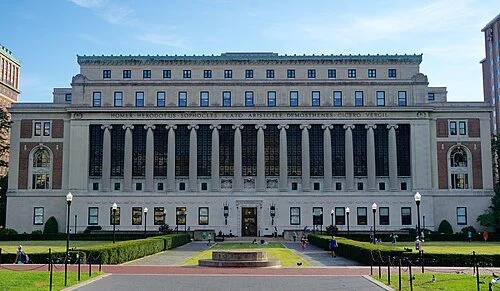
Butler Library at Columbia University (photo by JSquish)
Among essay coaches, admissions counselors, and English teachers, there is some disagreement about whether students should read examples of college essays before writing their own.
I am firmly in the camp that says: “Yes, absolutely!” When I was a classroom teacher preparing students for AP exams, I found that analyzing actual model essays (or “anchor essays” as they’re known in standardized testing circles) helped students understand the task before them in ways that no amount of lecturing about essays could. As a college essay coach, I find that reading sample essays, digesting them, seeing what worked and what didn’t—all of this is an important part of deciding how you’re going to tell your own unique story.
Why is reading others’ essays so important? As bestselling novelist Jean M. Auel put it:
“You learn to write by writing, and by reading and thinking about how writers have created their characters and invented their stories. If you are not a reader, don’t even think about being a writer.”
To that end, here are three sample Common App personal essays, excerpted from my book Write Yourself In (the book also contains two additional sample Common App personal essays, as well as examples of Why Our School, Contributions, and other supplemental essays). Instead of cramming the page with tons of essays, I decided to show you three superlative essays, each of which a) approaches the task at hand in a different way, and b) reveals something different about its author. What all three writers have in common is that they were highly successful: each was admitted to their top-choice college.
For additional insight on what makes a great college essay and how to write one, check out this article on writing a successful college essay and learn more about working with me one-on-one.
1. College Essay on Hockey: Seeing the Ice
Responds to Common App prompt 2: “The lessons we take from obstacles we encounter can be fundamental to later success. Recount a time when you faced a challenge, setback, or failure. How did it affect you, and what did you learn from the experience?” 650 words, small university/large liberal arts college
Four players are fighting for the puck. As my teammate gains possession, I race across the ice and receive a hard pass on my stick. Brushing past two defenders, I rush towards the net, drawing the goalie towards me. Then, I flip the puck to my teammate, who catches my pass and shoots into the unguarded net. Score!
I’ve loved the ice since before I can remember. From elementary school onward I lived, ate, and breathed hockey. Mornings began with hockey practice, afternoons with more practice and training sessions, and weekends with travel games. My friends at school knew me as “the hockey player,” and some of my best friends in the world are the guys on my team. Hockey is also where I first became a leader. Because of my skill and determination, my teammates looked up to me, and I led naturally. Even when I struggled with school or other parts of my life, the ice gave me confidence.
Then, in eighth grade, the unthinkable happened. My growth spurt was delayed, so while some of my teammates were suddenly 6 feet tall, I was still 4’10”. Where before I’d been a confident, dominant player, I suddenly felt like a defenseless minnow, surrounded by hungry sharks. Not only was I no longer one of the top players, but I had lost my edge and struggled just to keep up with my teammates.
As eighth grade progressed, things went from bad to worse, culminating in the day when my coach pulled me aside and explained I might not make the team next year. I was crushed. Not only had I lost the most important thing in my life, I was losing my identity. After all, if I wasn’t a hockey player, who was I?
I thought long and hard about what to do. I could have moved down to a less competitive team, or quit hockey altogether. But if hockey has taught me anything, it’s that when you’re faced with a challenge, you dig in and work harder. So I began taking more skating lessons, spent more time at the gym, got up at 5 am for extra practice sessions. Since I could no longer rely on speed or strength, my approach to the game became more cerebral. I taught myself how to avoid hits, and to use my opponent’s size against him. I also developed my ability to “see the ice” – to slow down the game, watch each play develop, analyze options, and think strategically – all in a matter of seconds. As I learned to see the ice, I got smarter. I struggled, but I stayed on the team and I stayed competitive.
The summer after ninth grade, my growth spurt finally came. I was larger in tenth grade, and by eleventh grade I was on par with my teammates. Now I had both size and skills, and I was proud to finish eleventh grade as the top scorer on my team and the second leading scorer in the entire league.
Equally important, I found that my new approach was transforming my life. As I started to “see the ice” at school, I realized that with hard work, my potential to learn was unlimited. So I tried harder, participated even more in class, and met with teachers before and after school. In the process, I developed a newfound passion for history, politics, and science. I also found myself taking on leadership roles in the classroom, and getting involved in causes I cared about, from cancer awareness to environmental activism.
Now, I can’t wait to take on new challenges. I’m still “the hockey player,” but I’m also a scholar, a leader, a problem-solver, and a thinker. Hockey has taught me that our greatest challenges are also the moments that give us the potential to grow the most, and that’s a lesson I will carry with me for my entire life.
Why the hockey essay worked
This essay takes a topic that some would dismiss as unsuitable for a college essay—sports—and succeeds by making it highly personal. It begins with a strong, dynamic opening that starts “on scene”: the writer places us on a hockey rink—even though he never uses the word “hockey”—in a moment of action. Reading this, we’re engaged, we’re energized, and we want to know what happens next.
The key turning point comes in paragraphs 4 and 5, where the writer acknowledges his vulnerability in this situation, admitting that he had almost been cut, had felt crushed, and risked “losing my identity.” Then he slows down and clearly explains his decision (“I thought long and hard about what to do”): a choice to dig in and work harder.
That decision helps him develop a new way to “see the ice” that not only makes him a stronger hockey player, it helps his performance at school and in other extracurriculars. What could have easily been a bland, impersonal story about hard work paying off is instead a highly personal, memorable tale of responding successfully to something big that’s totally out of your control.
This student was admitted Early Action to his first-choice school, eventually joining the hockey team as a walk-on varsity player.
2. College Essay on Poetry: Language and Confidence
Responds to Common App prompt 5: “Discuss an accomplishment, event, or realization that sparked a period of personal growth and a new understanding of yourself or others.” 648 words, mid-sized research university
I was sweating. A lot. But I wasn’t running a marathon or playing tennis. I was getting ready to stand for my rebuttal speech, and I heard everything—the creaking of the wooden floors, the judge’s exhales, my opponents’ persistent pen clicking. I walked to the podium and, for the next four minutes, stumbled through a disorganized volley of words. “Thank you, Ben,” the judge said. Although I liked the name “Ben,” it was not mine. I couldn’t even find the words to correct her so, head down, I shuffled back to my desk.
I’ve always been the “tech guy” and can usually be found in the robotics lab or behind a computer. If I ever needed to give a speech on stage, though, fear of public speaking stifled my voice. So, two years ago, I signed up for debate to tackle this issue. My knack for logic and mathematics helped me think through the issues, but after my first few debates, the truth became clear: I wasn’t very good.
A few weeks later, something unexpected happened. My English teacher asked us to make an “airplane poem”: open Pride and Prejudice to any page, select a line at random, copy it down, and repeat until we had a poem. Although I was doubtful, I nevertheless followed his instructions and was amazed as a poem formed in front of my eyes. Somehow, these randomly selected words had meaning. Did my interpretation of the words bring them to life? Was meaning present in the very words themselves? Was it both? I wasn’t sure, but I had felt the power of words and I was hooked.
Hungry to learn more about poetry, I started with poets I knew. As I read Edgar Allan Poe’s dark and twisted tales, Elizabeth Bishop’s precise descriptions, and Robert Frost’s conversational depictions of nature, I felt that I was beginning to see life through their eyes. Later, as I discovered Billy Collins’s quirky language and Wallace Stevens’s grand phraseology, I began to amass a collection of voices and perspectives in my head. Anthologies piled up on my shelf, and I even tried writing poems in the voices of my favorite authors. The more I read, the more I wanted to learn.
As I explored this world of poetry, I found my debate speeches changing. They became more personal, more understandable, more impactful. Over time, the process of immersing myself in the work of authors who had found ways to express their inner selves changed me: it pushed me to find language to express who I truly am. I realized that I, too, have a style, a way of using words to describe the world as I see it. Sometimes I may pair corny jokes with the cold clarity of logic, or I may simply reveal my emotions. As the debate season continued, I read my speeches over and over to my family, then to my friends, until the speeches felt natural and I felt comfortable. I was finding my voice.
A year later, at another debate tournament, I found my heart racing as my opponent delivered his speech. This time, however, I took notes with a steady hand. When the judge called time, I spent thirty seconds preparing for my rebuttal, leapt to the podium, and began. In that moment, I forgot that I was in a lecture hall. Instead, I was at home, in my room, writing a poem, creating a combination of words that worked. Each idea led to the next; the poem made sense, and my words rang true.
Will I ever be a Poe or a Frost? Probably not, and in truth I don’t know if I want to be—I want to be an engineer. But I’ll always be an engineer who understands the beauty of poetry, and I’ll always be grateful for the voice that poetry has helped me find.
Why the poetry essay worked
This essay was written by an aspiring engineering major who already had strong, clear engineering credentials (grades, test scores, summer programs, lab experience, etc.). That meant he didn’t need to rehash his engineering story in his personal essay, which freed him to write about something that would reveal a different side of himself to the admissions committee.
The text draws the reader in from paragraph 1 by showing the student in a moment of weakness that almost any reader can relate to (who among us hasn’t experienced stage fright?). Then, instead of simply becoming an essay about debate, it takes an unexpected turn to explore the origins of the student’s love for poetry, and how that journey helped him find his voice in a way that, in the end, gave him more courage when speaking in public.
This essay succeeds because it shows a number of key qualities admissions officers seek: resilience and personal growth, but also passion, creativity, and intellectual curiosity. The writer was admitted Early Decision to his first-choice college.
3. College Essay on Yearbook: Hit to the Corners
Responds to Common App prompt 7: “Share an essay on any topic of your choice. It can be one you've already written, one that responds to a different prompt, or one of your own design.” 647 words, large research university
“Hit to the corners, Rachel!” By tenth grade, I had heard that phrase shouted at me for years. Tennis has been a passion of mine since I was six, but regardless of how long I had played, I was a conservative player. Often I hit to the middle of the court: the safe shot. I wasn’t afraid of training hard, but I didn’t want to make an unforced error, so I stayed in my comfort zone, on the court and in life.
All of that changed sophomore year when I was selected as co-editor-in-chief of Lakewood’s yearbook. I was honored but apprehensive. Not only was a junior editor-in-chief unprecedented in my school, but the yearbook class was collapsing. The staff had shrunk from fifteen to three, causing efforts around the yearbook to become nearly nonexistent.
When my advisor told me the harsh reality that if I didn’t step up, there would be no yearbook, I knew what I had to do. The yearbook is a living record of students’ passions, voices, and opinions. The idea that it would cease to exist was incomprehensible to me, so I gathered up my courage, and said yes.
The months that followed were challenging. Creating our 200-page yearbook requires hundreds of hours of coordinated planning, outreach, design, and production. With only three people doing the work of fifteen, I was faced with a reality where if I played to the middle of the court, I was guaranteed to fail.
I began to strategize, starting with how I could expand and retain the yearbook team. The yearbook had never had official leadership roles (aside from editor-in-chief), so I decided to create new positions, from “Photography Coordinator” to “Business Manager,” which I hoped would attract students. Not every student I approached became a major contributor, but for many students, having a title empowered them, and our staff began to grow.
Simultaneously, in hopes of encouraging student involvement, I began to visit classes during my free periods, advocating for the yearbook. Over time, I found that this proved to be successful; for every three or four visits, one or two students would join. Some of my swings were misses, but others were winners, and slowly our team filled to capacity.
As the year progressed, I started taking more risks. When seniors failed to respond to our emails requesting quotes and photos, I decided to try unconventional methods of outreach, using different forms of social media to obtain information. To facilitate greater communication, I created a council of seniors to act as liaisons between the yearbook and the senior class, which enabled us to communicate with the entire class quickly and seamlessly.
I realized that, in the long term, one of the only ways to secure student commitment to the yearbook was to make it a credit-bearing class, so I began lobbying the principal. This was especially challenging; he was resistant and skeptical that offering credit would get more people involved. Refusing to be discouraged, I created a survey on yearbook participation, polled my peers, and gathered hard data to support my argument. After presenting the data, I persuaded the principal of the merits of my proposed program, and next fall, for the first time ever, Lakewood plans to offer yearbook as a credit-bearing class.
When I look back on the past year, I feel proud. Not only did we create a yearbook that reflects my school’s diversity, but I could have never imagined that the risks I took would transform into an incomparable life lesson. Although I can easily be content sticking to the safe shots, the only way to reach my goals is to complement those shots with a hit to the corners. I know that sometimes I may fail, but if I continue to work hard, persist through adversity, and try creative approaches, I can accomplish what would have otherwise been impossible.
Why the yearbook essay worked
This essay, written by a student applying to top-tier BBA (undergraduate business) programs, effectively narrates her experience navigating the challenges of leading—and ultimately transforming—the yearbook club at her school.
The process of reorganizing her school’s yearbook was complex and messy, but in writing the essay she broke it down into a series of manageable steps. Within each step, she described the challenges she experienced, what she did to overcome them, and the outcomes. She also included clear, tidy transitions showing how each step led to the next.
By the end of the essay, we have a clear sense of the writer as someone who has not only matured (she’s learned to “Hit to the corners” instead of playing it safe), but as someone who’s a creative thinker, willing to be persistent and resilient in accomplishing her goals. We also see her as someone who cares deeply about her school’s community, not so much in the story itself, but in how she tells it (for example, the commitment she reveals when she says “The yearbook is a living record of students’ passions, voices, and opinions. The idea that it would cease to exist was incomprehensible to me…”)
This student was admitted Early Decision to a top-tier BBA program, her first-choice school.
A note to parents: Writing college essays is challenging, and even the best-prepared students often struggle. If you’re wondering if your teenager could use support on their essays or the admissions process, reach out to learn more about how I work with students one-on-one.
Frequently Asked Questions
-
The short answer: most of the time, it doesn’t matter. In fact, some admissions officers don’t even read the prompt before reading the essay. What’s important is what’s in the essay, not the prompt you choose.
That said, you do have to choose a prompt! Simply pick the prompt that seems most relevant to your essay. If there’s any doubt in your mind at all, select prompt #7: “Share an essay on any topic of your choice.”
I usually have my own students choose the prompt at the very end of the process, as they’re pasting the essay into the Common App.
-
First, the hard rules: the maximum allowed length for the personal essay is 650 words, and the minimum length is 250 words.
My general length recommendation for any college essay, main or supplemental, is that the essay should be at least 80% of the max allowed. For the personal essay, that means your essay should be at least 520 words.
Practically speaking, however, the strongest essays tend to be close to the 650-word maximum. If you’re applying to highly selective colleges, your personal essay should be 600-650 words in length.
-
The most important decision you can make is to pick a topic that’s personally meaningful to you. If you tell a story in your own voice that you truly care about, that authenticity will come across to the reader — and authenticity is a key quality in college essays.
For most students, the Common App Personal Essay is the hardest thing to write because it can be about literally anything! When I work with students one-on-one, a lot of our work is on brainstorming suitable topics and picking the best one.
-
Avoid topics that are offensive, that highlight your privilege without contextualizing it, or that discuss mental health issues in such a way as to raise a red flag (more on writing about mental health in Write Yourself In, pp. 81-85).
Otherwise, any topic is fair game! What matters is what you, personally, have to say about the topic, not the topic itself. For example, some people say to avoid writing about sports, but I’ve had students admitted to very top schools with essays about athletics. However, each had something deeply personal and authentic to say (not just “I struggled, got better, and learned that hard work pays off.”). As a Yale admissions officer once told me, “The topic matters less than the voice.”
